Wednesday, December 13, 2023

Three pillars of Sustainability: Social, Environmental and Economic


Three pillars of Sustainability: Social, Environmental and Economic

 In the literature relating to sustainability mainly three pillars of sustainability are identified. They are social, environmental and economic.  To put it differently, people represent the social pillar of sustainability, the planet represents the environmental pillar of sustainability and profit represents the economic pillar of sustainability. In order to understand the consequences of our actions in a better manner in terms of sustainability it is necessary to understand the interconnections and interactions which exist among environmental, social, and economic factors.


It is found that  these three pillars are graphically represented using Venn diagrams, concentric circles and literal pillars. In the Venn diagram the three circles intersect each other at some points. The intersecting portion is depicted as sustainability.  In the Venn diagram independent the circles are  there and the intersections indicate that somewhere they are overlapping each other.  It gives a message that even though three pillars are independent they are interconnected. In the concentric circle, economy is at the centre followed by social and environmental. Social, environmental and economic are depicted as three pillars of a house which is called sustainability.  The article “Three pillars of sustainability: in search of conceptual origins” written by Ben Purvis ,Yong Mao and  Darren Robinson published in  Sustainability Science (2019) gives adequate insights on how these pillars  evolved in the discourse of sustainability from a historical perspective.

These three pillars have been widely popularized, businesses, governments, and organizations since the 1980s to show their commitment to sustainability in their practices.  It is true that we cannot think about sustainability without considering these three pillars. The UN's 17 Sustainable Development Goals adequately represent these pillars  of sustainability .

It is based on the presentation made by Dr. Siby K. Joseph, Director , IFPNP, Sevagram Ashram Pratishthan, Wardha, MS, India. 


Friday, December 8, 2023

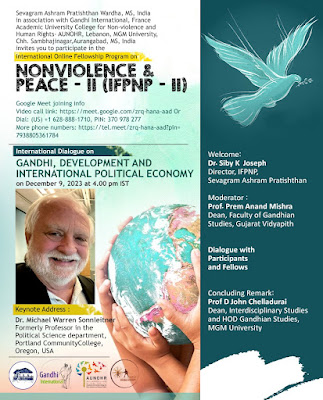
Gandhi , Development and International Political Economy

 International Dialogue on
Gandhi Development and International Political Economy 
 on  December 9, 2023 at 4.00 pm IST 


Sevagram Ashram Pratishthan Wardha, MS, India 
in association with 
Gandhi International,  France
Academic University College  for Non-violence and Human Rights- AUNOHR, Lebanon
MGM University, Chh. Sambhajinagar,Aurangabad, MS, India


Google Meet joining info
Or dial: ‪(US) +1 628-888-1710‬ PIN: ‪370 978 277‬#


                              International Dialogue on
Gandhi Development and International Political Economy 
                        on  December 9, 2023 at 4.00 pm IST 
                                    Programme 


Welcome : Dr. Siby K. Joseph ,Director, IFPNP, Sevagram Ashram Pratishthan

Moderator :Prof. Prem Anand Mishra , Dean, Faculty of Gandhian Studies, Gujarat Vidyapith

Keynote Address : Dr.Michael Warren  Sonnleitner

 Formerly  Professor in the Political Science department Portland Community College ,Oregon, USA

 Dialogue with Participants and Fellows

Concluding Remark: Prof D. John Chelladurai ,  Dean, Interdisciplinary Studies and HOD, Gandhian Studies, MGM University 


Outline  of Presentation 
Gandhi, Development, &International Political Economy”
by Michael Sonnleitner


I. CONTEXT: Gandhi, COP 28, &Environmental Crises.

“Development”: Political &Personal AND Economic (Maslow’s Hierarchy of Needs).

II. APPROACHES to IPE (International Political Economy):

1) Economic Nationalism: Ideological Foundations &Consequences

2) Economic Internationalism: Ideological Foundations & Consequences

3) Economic Structuralism: Ideological Foundations &Consequences

4) Economic Empowerment: Gandhian Foundations &Consequences

III. ECONOMIC EMPOWERMENT (Sustainable GREEN Development)

A. Ideological Components:

1) The Golden Rule (Assumption) related to Rta & the Law of Karma

2) Ahimsa/Nonviolence (Belief) related to Sat (Truth) &Tapas (Sacrifice)

3) Swadeshi/Self-Reliance (Goal) related to Moksha & Swaraj (Self-Rule)

4) Sarvodaya (Strategies) related also to Brahmacharya & Satyagraha

B. Consequences: Personal, National, & Global Self-Actualization

Living with one another in greater harmony with Gaia.

IV. QUESTIIONS & DISCUSSION


Resume/Vitae:

Michael Warren Sonnleitner 

Birthplace: Wichita, Kansas, USA (July 11, 1949).
(“maiden” name before 1983 marriage: “Johnson”); Wife: Kristine; Children: Margarita, Sonrisa, Shaman, Mira.

Home Address: 1037 S.E. 80 th Ave., Portland, Oregon, 97216-3010. Home Phone: 503-285-5827.
Personal email: soulom2u@hotmail.com PCC email: michael.sonnleitner@pcc.edu Cell Phone: 971-988-2427.

EDUCATION: PH.D. University of Minnesota (Minneapolis): March, 1979. M.A. March, 1976.
Major: Political Science; Supporting Program: India/China Area Studies.
Examination Areas: U.S. Constitutional Law, History of Political Thought, Comparative Political Systems.
Dissertation: Soul Force & Social Change according to Mohandas K. Gandhi & Martin Luther King Jr.

(Lambert Academic Publishing: Latvia, EU, 2019.) ISBN#: 9786200314185.
B.A. Whitman College (Walla Walla, Washington): June, 1971 (Phi Beta Kappa, Summa Cum Laude,
with Honors in Political Science & transfer credits from Fisk University in Nashville, Tennessee).
High School Diploma Highline High School (Burien/South Seattle/SeaTac, Washington): June, 1967.

Elected Trustee (Zone 3), Portland Community College Board of Directors (2015-2023).

Co-Chair, PCC Board Committee on Diversity, Equity, & Inclusion (2018-20); Vice-Chair,
PCC Board of Directors Audit Committee (2018-21); Oregon Community College Board representative (2020-2023).

Portland Community College: RETIRED Full-Time Political Science Instructor: 27 years (1988-2015).
NOTE: Originally hired as full-time to a split-appointment, I have taught courses at PCC Sylvania (1988-2003),
PCC Rock Creek (1988-2011), PCC Cascade (2000-2015), and PCC S.E. (2004-2007 & 2013-15).

2007-2023: Portland State University: Graduate-level courses taught part-time for the M.A. Program in Conflict
Resolution; Undergraduate courses also for Political Science Department

1985-1987: University of Northern Iowa: full-time assistant Professor of Political Science.
1984-1985: Loyola University of Chicago, University of Illinois at Chicago; Northwestern Illinois University: part-time Instructor of Political Science teaching Judicial process, U.S. Security Policy, Politics of China &; Japan.
1979-1983: Illinois Wesleyan University: full-time Assistant Professor of Political Science.
1973-1979: University of Minnesota (Minneapolis): Teaching Assistant & part-time Instructor of Political Science.

FULBRIGHT SCHOLAR in India: six months (November 29, 2009 to May 29, 2010).
PROJECT TITLE: “Teaching Peacebuilding for Social & Structural Change in Multicultural Societies & a Multipolar World”.
COURSES TAUGHT: (at St. Thomas College, Palai, Kerala): Gandhian Thought; American Government; International Issues.
(at Mahatma Gandhi University): International Relations: Theory & Practice; Nonviolent Action.

Other Training/Travel Experiences:

Ten weeks in India: participating in the Bharat Jodo Yatra, teaching “Gandhian Nonviolence & lecturing: Jan-March, 2023.
Five weeks in India: lecturing on Gandhi & participating in a re-enactment of the Salt March of 1930: Feb-March, 2020.
Two weeks at a China Seminar at the East-West Center (University of Hawaii-Manoa) Title VII Grant: Summer, 2013.
Fulbright Scholar returning to the U.S. via Italy (one month), Israel & Palestine (one month), & Egypt (one month): 2010.
Invited Scholar to the International Association of Gandhian Studies Conference in New Delhi: 1987.
Delegate to the UNICEF International Seminar on Training for Nonviolent Action (3 weeks in Mexico): 1977.
Summer Peace Internship working with kids during the “troubles”: Londonderry (Derry), Northern Ireland (2 months): 1974.
Thomas J. Watson Fellowship: to study "Experiments in Nonviolent Action" in India (6 months), & 1-4 weeks in Japan,
Hong Kong, Thailand, Pakistan, Afghanistan, Republic of S. Africa, Italy/Sicily, & Great Britain: 1971-72.
Exchange student attending Fisk University in Nashville, TN: autumn of 1969.
U.S. Senate Internship (in Washington, D.C. Office of U.S. Senator Henry M. Jackson): Summer, 1969.

Orchard worker at Auvil Fruit Company, Orondo, Washington (with migrant workers): 15 summers during 1962-1981.

Other Awards/Honors:
Invited Keynote Speaker for Centennial Celebration at Gujarat Vidyspith (Ahmedabad, India): January 10, 2023.
Elected President, Peace & Conflict Studies Consortium (Pacific Northwest regional association): April, 2007-2010.
Outstanding Faculty Person of the Year Award (Portland Community College, Rock Creek ASPCC): 2006.
Male Faculty of the Year Award (Portland Community College, Rock Creek ASPCC): 2000.
Nominee for Portland Community College Faculty Excellence Award: 1992, 1998, 2003.
Excellence in Teaching Award: Illinois Wesleyan University: 1982
All-expenses fellowship grant for graduate study in Political Science at the University of Minnesota: 1972-75.
Ford Foundation Graduate School Fellowship recipient at the University of Minnesota: 1972-75.
Thomas J. Watson Fellowship to study ‘Experiments in Nonviolent Action” abroad: 1971-72.
Sloan Foundation Scholarship recipient at Whitman College: 1968-71.

COMMUNITY INVOLVEMENT IN OREGON:

82nd Ave. Improvement Coalition (June of 2014-2023): Coordinating Committee member & member of the 82 nd Ave.
Business Association Board (2018-present); successfully lobbied for a $200,000 study
funded by the Oregon Department of Transportation and jurisdictional transfer to the Portland Bureau of Transportation in 2022.
Interfaith Movement for Immigrant Justice (2007-2020): formerly the “New Sanctuary Movement”; helped to
develop support networks for undocumented persons; seeking meaningful
immigration reform via educational actions; achieved passage of the expanded Oregon Sanctuary Act in 2021.
Ascension Catholic Church (2004-2020): assisting my wife in providing occasional educational programs as well as participating in various fundraising efforts (like the annual Spaghetti Dinner), and service activities associated with the Daybreak Homeless Shelter Network. Now also attending St. Anthony Catholic Church.
Daybreak Homeless Shelter Network (2004-2017): assisting houseless families in S.E. Portland in a variety of ways; moving beds, serving meals, sleeping overnight, playing with kids, and helping to
provide bus/van transportation between the day shelter and Ascension Church as part of the rotating evening host institution.
Montavilla Neighborhood Association (January of 2014-2017): regularly attending meetings, Chair of the Board (2015-16), otherwise Vice Chair. Became more involved in the neighborhood where my family lives, on issues ranging from land use to transportation, affordable housing and crime issues.
S.E. UPLIFT (March of 2014-2016): attending meetings, serving as an active Board member (at large), having also gone to meetings of most of the 20 neighborhood associations with members elected to the S.E. Uplift Board as a means of facilitating communications and action among groups with common community concerns.
PCC PACS Program (1990-2015): facilitated establishment of Portland Community College (PCC) Peace & Conflict Studies (PACS) Program (1988-90), the first at any community college in the U.S.; PACS Program
Chairperson or Co-Chairperson (1990-present); NEWSPEAK coordinator, fostering weekly &free speech; events at Sylvania Campus (1998-2003), setting similar traditions Rock Creek (2004-2011), and at Cascade (2004-2005 & 2011-2015).
PCSC (1988-2017): Peace & Conflict Studies Consortium (previously the Oregon Peace Studies Consortium): Board member representing the PCC PACS Program (2004-2015), helping organize annual regional gatherings and two national conferences; serving as President (2007-2010).
DaVinci Middle School (1998-2002): was among the 20 founding families who created, organized, and functionally serving as the staff for this Arts Magnet Charter School within the Portland Public School (PPS)
District; also served on a PPS Committee to set up criteria to review applications to such all schools.
Foster Parent Program (1998-2000): my wife & I were trained as foster parents under emergency conditions, providing a home to an undocumented teenager, who we later supported to complete her high school and community college degrees, gain dual U.S./Mexican citizenship, and Margarita became a daughter to us.


Self , the Other and the Nature


Self and the Other


1.    The dominant Western philosophical tradition emphasizes the self as the isolated, separate, autonomous entity, while in dominant Indian tradition the self is a relational one. Following the Advaita tradition of Indian philosophy, Gandhi did not see the  self-separate from the Self at the abstract level. He called it true self, real self, or permanent self or soul. However, in embodiment or body-self complex, he did not consider the self without its essential positive and negative relations with  the other. His philosophy prescribes us about the self-controlled body, social-relational view of  self,  and otherness as ignorance. In this concluding chapter, we will see how these ideas can be employed or implicated in the  concrete reality of our time.

2.    Gandhi provides a radical inversion of the  primacy of one’s  own self or ego. This inversion is grounded in his metaphysics and ethics. For him, ethics is the  first  philosophy. He wrote, ‘ With me moral includes spiritual... In my career as a reformer, I have regarded everything from a moral standpoint. Whether I am engaged in tackling a political question or a social or an economic one, the moral side of it always obtrudes itself and it pervades my whole attitude’ He breaks the construction of traditional religion, philosophy, and politics. He did not accept those thinking, political, social, or economic, that claims to be value free or value neutral. Nor he viewed power relations free from moral considerations. He did not even consider religion as a made of salvation based solely on faith in some supernatural deity. As known, to him, politics and religion are grounded in morality. He focuses his attention on individual moral human relations. For him, ethics and politics are not separate entities.

3.    On this grounding, Gandhi’s worldview calls for meaningful ethical, political, social, an economic relations with others while focusing on the primacy of others. This is not only the rejection of the dominant liberal capitalist view but  also its inversion. This radical inversion is quite apparent in  his famous talisman that serves the need of others. The talisman focuses not on one’s own self but instead on the other with the  greatest needs. Indirectly, it also suggests that how one should have a responsibility towards others. Gandhi calls to uphold authentic human values and engage in authentic social and political change only when we assume moral responsibility for  the welfare of the other. This of course requires much effort which essentially involves ‘self- restraint’, reducing one’s ego or ‘self to zero’ What does it mean by reducing oneself to ‘zero’? When Gandhi is talking about reducing the self to zero, he is focusing on the I-me, egoistic, separate ego or self. in traditional Indian terms, I-me is not the authentic spiritual self, but the karmic, maayic, illusory self-construction that establishes unethical and unspiritual relations. In Gandhi’s perspective, it is only when one overcomes this focus on the primacy of one’s own self/ ego and instead focuses on the primacy of the needs of the other that one  begins to experience the  deeper, true, moral, and spiritual Self and establishes authentic self-other relations.

4.    These ideas should not be considered as an abstract moral philosophy of Gandhi. Nor it is essentialist, non-contextual, and a historical. He, in fact, did not formulate his philosophy as offered here. These ideas emerge from his praxis that we notice in his political career. Gandhi’s thinking and practice focus on the concrete social and political processes which include self-other relations in a dynamic way. Through his dynamic self-other relation, he attempts to constitute human relation and social-political institutions on a totally different ground. It was his theory of truth and nonviolence that provided him the ground to reconstitute the human relationships and institutions to enact social-political changes. In other words, his praxis informs that he was pragmatic in his approach and concerned with the political effectiveness of self-other dynamics. Through changing the self-other relation on the  ground of nonviolence and truth, he tried to transform the very nature  of exercising power an power relation within society and politics.

5.    In Gandhi’s self-other relation proposal, other does not include  the only individual but also social-political, and economic institutions. He did not consider any institution very neutral. The reason, institution may be impersonal in nature but it works through the individual. Further, any  institution originates to serve the purpose of human needs. Thus, it cannot be  value-neutral. Second, no institution can be  superior to the  individual  and human being. Thus, he argues, the domination of institutions over individuals must be challenged. As the self is related to others with responsibility, for him individual is also responsible for the institutions he develops and through which he manages his life. If the institutions do goal, it must be transformed. As he considers the individual as a moral being, he attempts to evaluate, assess and  redesign the socio-political and economic institutions  on the  line of morality. It  is here Gandhi’s radicalism emerges against  the twenty-first century impersonal, centralized, value-neutral social-political, and technocratic structure. Moreover, the existing methods to solve the problems of the twenty-first century are not acceptable to Gandhi. He offers his prescriptions.


Self and the Nature


1.       Self and nature and Gandhi’s take on it- This question is very much pressing today as we are facing the crisis of climate change, sustainability, depletion of resources, development model, environmental pollution and ecological imbalances. The crisis is not only alarming but it has put the very question mark on the survival of the whole of humanity. The present crisis is fundamentally the result of our mode of relation with nature.

2.       How do we (self) see nature (other)? And, what do we feel about nature? Our response to these questions depends upon our worldviews. There are two dominant worldviews on it – the western worldview developed after 1500, and the oriental worldview. Before 1500, in all societies and civilizations, the image of nature was seen as an ‘organism’ and it had a strong effect on the people.


3.       In the west after 1500 AD, the ancient concept  of the earth as nurturing mother was radically transformed by two main dominant trends of philosophic inaugurated by Francis Bacon (1561-1626), and Rene Descartes (1596-1650).Their philosophy and ‘methods of inquiry’ replaced the organic view of nature with the new metaphor of the world as a ‘machine’. Francis Bacon who called his philosophy ‘new philosophy’ was  different from other philosophies because it aimed at practice rather than theory. It focused on the search of  proof, rather than a doctrine. It worked with something concrete rather than speculation. Knowledge, according to him is not an opinion, but a work that has to be verified. He further claimed that knowledge should have utility and power. Bacon advocated the ‘new empirical method’ of investigation in the field of natural science and it completely changed the existing view of  nature. Through this, new empirical method, he offered aggressive views on nature.


4.       Nature, in his view, had to be ‘haunted in her wandering’, ‘bound into service’, and made ‘slave’. Nature was to be  ‘put in constraint’, and the aim of science was to ‘torture natures’ secrets from her’. This was a major shift from existing views on nature seen as ‘mother’. As Capra points out, this shift became of overwhelming importance for the further development of western civilization. Later on, this shift was completed by two more important figures- Descartes and Newton.


5.       Descartes, regarded as the founder of modern philosophy, offered the method of radical doubt and reductionism. His view on nature on nature was based on the fundamental division of two independent and separate realms – that of mind, or res cogitans, the ‘thinking thing’, and that of matter, or  res extensa, the extended things. To Descartes, the material universe was a machine and nothing but a machine. There is no purpose, life, or spirit in matter. Nature worked according to mechanical laws, and everything in the material world could be explained in terms of the arrangement and movement of parts. Newton, later on, tried to give a picture of the world as a ‘perfect machine’ by incorporating the empirical inductive method of Bacon and the rational deductive method of Descartes. This methodological shift of worldview completely changed the western worldview of nature. Science, technology, and society developed along this line, and self got completely separated from  nature in contemporary time.


6.       The oriental tradition and civilization view nature as an ‘organic whole’. The influence of self-nature relation has constructed an ethos of respect to nature in more or less in all oriental tradition. The separation has been understood as a deviation from the path of the divine. Particularly, Indian philosophical tradition also tells us our Indian ethos of human-nature relation. In Isopanishad, over 2000 years ago, one notes, ‘This universe is the creation of the Supreme  Power meant for the benefit of all his creation.  Each individual life-form must, therefore, learns to enjoy its  benefits by forming a part of the system in close relation with other  species. Let not anyone species encroach upon the other’s rights. More or less the direct kink of the human being with nature is the same in most of the Indian philosophical system except Charvaka. In Indian practice, still in India and most of the oriental countries, barring some western educated and elite minded, in twenty-first century we observe that people worship moon, sun, rivers, mountains, and many animals as social religious rituals. Although such worship is regarded as superstition by rational people and they may have some point but it cannot be denied that it tells us that most of the people respect nature and feel obliged to it.

7.       This is the social-cultural ethos, whether they are rational or irrational, scientific or unscientific that might be debated, in which people act. There are two ideas that we may derive from this ethos. First, we (self) are not separate or apart from nature. And second, we respect nature and feel responsible to nature for our actions towards it. In a recent study, this aspect of the relation of self with nature has been highlighted by some scholars. Although they are not based on Indian experiences but their suggestions are quite common with more or less with Indian ethos.

8.       One such concept and practice of ‘deep ecology’ proposed by Arne Naess. Self-realization is the ultimate objective of deep ecology. In keeping with the spiritual traditions of our culture, the deep ecology norm of self-realization goes beyond the Western ‘Self’, which as mentioned, is seen as an isolated ego striving for a narrow sense of individual salvation. Deep ecology ‘self’ requires an identification that goes beyond humanity to include the non-human world. It emphasizes that we need to see beyond our narrow contemporary cultural assumptions and values and the conventional wisdom of our time and place is best achieved by the meditative deep questioning process. Symbolically, self-realization is a realization of self in Self, where Self stands for an organic whole.

9.       On the other hand, Schultz, in his recent study, shows deep concern about how we should connect with nature. He has pointed out three psychological components in our response to nature –cognitive, affective, and behavioural. He also notes ‘three core structural components by which one deals with nature- connectedness, caring, and commitment’. Our dealing with nature has also been viewed by Olivos and Aragones (2011) who coined the term ‘environmental identity’. They suggest that environmental identity consists of four dimensions: environmentalism, appreciation of nature, enjoying nature, and environmental identity (Olivos and Aragones, 2011: 66). Similarly, Clayton also constructs a notion of ‘environmental self- identity’ and argues that environmental identity is only one part of it. He observes,’... environmental identity is one part of the way in which people form their self- concept; a sense of connection to some parts of the non-human natural environment, based on history, emotional attachment, and/or similarity, that affects the  way  in which we perceive and act towards the world; a belief that the environment is important to us and an important part of who we are’ (Clayton, 2003: 45-46). In short, now scholars seem to agree that there is a vital connection between our worldview and our attitude towards the earth. Understand and observing this connection in personal and public life may save us from extinction.

  Now see, how Gandhi sees the relation of self with nature and its implications on us. He did not provide any systematic views on it; however, one may derive it from his philosophical position. As noted, the ultimate goal of Gandhi was the attainment of moksha, or self-realization or see the god face to face. He defined God as truth as soverign law. He noted that ‘law and lawgiver are same’ and everything in this universe is the reflection of truth. His philosophical position on truth reveals that the individual or part is not separate from the whole and everything in this universe is linked like a chain. He believed in the concept of Advaita (non-duality) and as he wrote. ‘I believe in Advaita, I believe in the essential unity of man and, for that matter, of all that lives’  In this concept the world  is one, there is no division between man and nature. He believes ‘if one man gains spirituality, the whole world falls to that extent’ . He also noted how the individual self can be one with the universal self. ‘To see the universal and all-pervading spirit of truth face to face one must be able to love the meanest of creation as oneself. And a man who aspires after that cannot afford to keep out of any field of life’ .

1   His intervention on environmentalism is getting currency. Although during his time, there was no such problem like climate change, environmental degradation, depletion of natural resources or ecological imbalance but his philosophy of relation of self-nature provides a dominant platform to reconstruct our worldview. Is notion of simplicity, focus on needs rather than wants, the idea of non-possession, and understanding oneself as a part of nature and act accordingly are some of the issues that may help us to think new and intervene in our new reality of twenty-first century.

 Summary of presentation made by Prof. Prem Anand Mishra, Dean, Faculty of Gandhian Studies, Gujarat Vidyapith, Ahmedabad, Gujarat, India   


Thursday, December 7, 2023

Causes of Conflict


 Causes of Conflict

I. Causes-I: Primordial paradox: Humans are torn between two realities:

Reality 1:  Human life is experienced essentially at the individual level. Every individual is unique. And every individual is sovereign.

Reality 2:  Humans are social being, individual cannot live alone.  There is no life except            through society.  Life is actualized (earned) only through the society. Humans have to live together. Society is the second name of the individual.

Individual while being different from one another, are expected to live together.  Individual and society while mutually being different, one is expected to lead social life even at the individual level.

This inevitably cause friction. This friction is called conflict.   

 II. Binary Opposites

Life is co-determined by pairs of opposites.  North-south, Day-night, male-female, life and death, going out of house and coming into house, start eating and stop eating, start working and stop working, yes to food and no to food...

Every aspect of life is co-determined by the pairs of opposites.  Apparent contradictions actually complement life. Inability to comprehend this complexity is a cause of conflict.  Individual’s inability to reconcile with the counter position, prompts him to see the person on the counter position as contradictory. The truth may be, the other person is, just different.

III.  Non-realistic ventilation

When people are subjected to unperceivable latent conflict, frustration accumulates in mind.  Unable to tolerate, the person allows it to spill over the neighbour at any slight pretext, some times even without a reason / cause.  Such unprovoked conflicts are mostly non realistic ventilations leading to further conflict.

Human tendency to ventilating frustration on an unprovoked neighbour is a cause of conflict


IV. Conflict Proliferation and Spiral

Conflict when expressed violently is counter productive, for, violence begets violence.  When an Actor initiates a conflict with one grievance and if s/he adopts violence, the Alter, instead of seeing the reason for the conflictof the actor, most likely to see the violence (means) of the actor and  make it a grievance for him/her and initiate a new conflict based on this.  Thus the Actor ends up with two grievance.  This is how conflict spirals.

Human tendency to be violent in one’s reaction is a cause of conflict.

V.                 Values and Catalysts

Values are those attitudes, behavioral principles and concepts that smoothen the conduct of relationship, for mutual gain.   Love, compassion, trust, belief, faith, honesty, forgivenss, help, are values, for, they are valuable characteristics in our reciprocal human relationship.

The cardinal principle, however, is Life. All other values are derivatives of Life.  Those which give benefit to life are valuable and those put life in difficulty are not.  Positive values help conducting conflict inclusively.  Negative values (hate, distrust, enmity, exclusivity…) not only spoil that prospect, but deteriorate conflict into a bitter experience.


Positive catalysts help conduct conflict towards a pro-life end

Negative catalysts lead conflict towards a destructive end


Catalyst –Positive

Fearlessness, Faith in the goodness of the other (human), concern for the opponent, Empathy, Morality, Openness, transparency,  Introspection, Confining to conflict points, Readiness to compromise, voluntary initiation of dialogue, Quest for peace, Ability to comprehend the situation,

Catalyst – Negative

Fear, Force, Bad language, Exaggeration, Secrecy, Distrust, Prejudice, Adding new conflict issues, Emotion, Rumour, Tit-for-tat, stereotype, mirror-image, black top illusion ( ‘the people on the opposite quarter are good but their leaders are bad’ sought of opinion), Apathy

VI.               Denial, Deprivation or scarcity


Abraham Maslow enlisted needs are fundamental for a human to lead a dignified and complete life.  The non-availability, denial or deprivation of these needs is a definite frustration in the pursuit of life.  Thus non-availability of these needs becomes a sure cause of conflict.

 VII.            Frustration Aggression Hypothesis

Impediment to life is called Frustration.  Deprivation / denial (of physical, emotional, cognitive needs and the skills / tools  necessary to achieve them) is perceived as impediments and therefore frustration.


The sight of (occasion of) Frustration creates a series of psycho-somatic reactions.  First, frustration activates the hypothalamus, which through pituitary gland activates adrenaline.  Adrenaline activates our body organ, particularly the muscles to function faster, the lungs to supply more Oxygen into the blood, and the heart to pump the O2 carrying blood faster to all over the body.  And the person is now hyperactive.

Uncontrolled frustration is likely to degenerate into hatred, anger, enmity and manifest in the form of norm-less vengeance and violence.  It may also turn into hopelessness.

A Lion chasing the prey is goaded by aggressive energy = its frustration is the difference between degree of its hunger and rate of (in) accessibility of food (inaccessible but in sight).

The deer fleeing the sight of a tiger is also activated by aggressive energy = the frustration is the difference between the instinct to live and the imminence of death (in sight).

Every challenge in life is a small piece of frustration.  More challenging a frustration is, greater the aggressive energy it generates (we experience).

Human gets aggressive at the point of frustration, and can equally be aggressive at the point of ‘perceived’ frustration.  Thus a person can get agitated if s/he perceives a threat from outside, even if there is none actually.


VIII.   Systemic and Structural inadequacy

Civic amenities and infrastructural requirements have to be sufficiently provided and the members be oriented to the availability, procedures and function of the systems, for the best conduct of system for the best benefit of individual members.  Primary infrastructures such as water service, electricity, communication, transportation, education, health, production, market, banking…. Needs to be equitably arranged, people oriented to their function, given soft skill to be part of those systems for reciprocal / symbiotic relationship.

IX.  Social Fabric – ripples effect  :

Social Fabric analysis reveals that we are integrally connected to one another in the society.  Hence, individual welfare is contained in the welfare of all.

As the relationship with fellow beings have grown to the level of organic relations, today, any act of killing or hurting is self-infliction / suicidal.

As the other person is none other than my own extended self, we have no reason to hate, antagonize or nurture enmity against. 

Whereas non-realization of this organic relationship creates high rate of friction with person who are close to us in the organic set up of the society, that is a conflict by itself.

X.         Social Actualization

Awareness of one being a member of the larger society, necessity for reciprocal  . symbiotic life by maintaining organic relationship is essential for life is called social-consciousness.  Absence of such consciousness, especially when we lead a complex social life, is a cause of conflict by itself.

A nation which has constituted itself into a democratic republic (every individual in the nation is primary stakeholder, owners of the nation) facilitate a long process of uniform collective enlightenment (consciousness of being a nation in its fullest sense), and enables every one of its member to actualize one’s life in the fullest sense.   Such development is called social actualization.  Absence of a process towards social actualization in a republic is a cause of conflict by itself.

When a nation allows (knowingly or unknowingly) the prevalence of exploitation, discrimination, inequality, injustice among its people, such unhealthy social condition is a definite structural cause of conflict within.


 Prepared and shared by:D John Chelladurai,  Prof. and Head, Dept of Gandhian Studies, MGM University; djohnchelladurai@gmail.com ; hod.gandhianstudies@mgmu.ac.in ; +91 - 94 219 25 146 (whatsapp)

Online International Fellowship Programme on Nonviolence and Peace

  https://nonvpi.in/index.php/2026/08/25/international-online-fellowship-program-on-nonviolence-and-peace/